
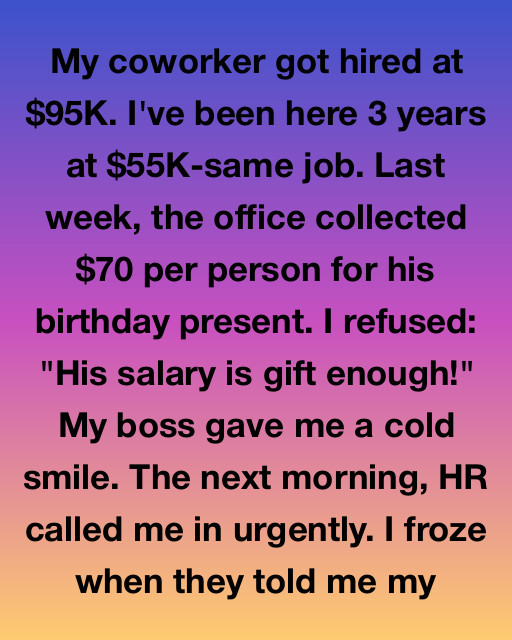
I’d spent three solid years at that company doing far more than my job description ever hinted at, all for a salary that barely kept my head above water. Fifty-five thousand a year, juggling responsibilities meant for at least two people. I didn’t raise my voice or make scenes. I assumed that if I worked hard enough, someone would eventually notice.
They did notice—just not in the way I hoped. They noticed I wasn’t a problem.
Then the new guy arrived.
He walked in dressed like he belonged in a magazine spread, blazer crisp, confidence polished. People whispered about how impressive he was, how seasoned, how put-together. On his very first day, he casually mentioned his salary like it was trivia: ninety-five thousand a year. Same position. Same workload. Same title.
I laughed, because sometimes laughter is the only thing stopping you from losing it entirely.
That feeling didn’t last long.
A week later, the office manager sent a message to the team chat announcing we were all pitching in seventy dollars for his birthday gift. Seventy dollars—for someone earning nearly double what I made.
I stared at my phone, feeling my patience finally snap.
I typed, “His paycheck is generous enough. I won’t be contributing.”
Then I sent it.
The chat went dead quiet. No typing bubbles. No jokes. Just an awkward digital pause.
Then came the reactions: confused emojis, nervous “lol” responses that weren’t funny, and finally a message from my manager telling me to stop by her office after the morning meeting.
She greeted me with a smile that felt more like a warning.
“We need to maintain professionalism here,” she said.
“And I need to be paid fairly,” I replied.
Her expression tightened, and she ended the conversation abruptly. Strangely, I wasn’t scared anymore. I’d crossed that invisible line where frustration outweighs fear, and honesty slips out whether it’s welcome or not.
The next morning, an email from HR landed at 8:02 sharp.
“Urgent meeting. Please come immediately.”
My stomach sank. That elevator ride felt endless, the kind where you prepare for bad news before it’s even delivered.
Inside the HR office, both reps were waiting, hands folded neatly. I sat down, already assuming the worst.
One of them spoke first. “Your manager reported that you declined to participate in team activities.”
Great. This was how it ended—over a birthday present.
Then the second rep spoke, her tone calmer. “We also conducted a compensation review. Your concern raised some issues we hadn’t previously identified.”
I blinked. “That wasn’t really my goal,” I said, though part of me knew it should’ve been.
She slid a folder across the desk.
Inside was a formal letter outlining a salary adjustment. Not a token raise, but a massive one—up to eighty-eight thousand a year. Retroactive pay for six months. And a title update that finally matched the work I’d been doing all along.
I stared at it, stunned.
“Your manager failed to accurately represent your contributions,” the rep explained. “She also approved a salary for a new hire without proper review. After evaluating your performance, it was clear you were significantly underpaid.”
“So… I was underpaid, and he was overpaid?” I asked.
The two HR reps exchanged a knowing look.
“We’ve opened an internal review,” one said.
I walked out clutching that folder, legs unsteady, unsure whether to laugh or cry.
By lunchtime, my manager’s desk was empty.
People whispered. Some said she’d been escorted out. Others said she’d been reassigned. HR didn’t confirm anything, but whatever happened wasn’t quiet.
The new hire suddenly kept his head down. Not out of guilt—but because he learned the salary he bragged about wasn’t supposed to exist. HR adjusted his pay to fit the proper scale. Still comfortable. Just not excessive.
Later, he found me by the coffee machine.
“I honestly didn’t know,” he said awkwardly. “About the pay difference. Or the gift thing.”
“I know,” I replied. “None of that was on you.”
He nodded, relieved.
After that, we worked well together. Not close, but respectful.
Two weeks later, the company announced new policies: clear salary ranges, routine audits, no more secret deals. People said I sparked it.
I didn’t feel brave. Just exhausted by pretending everything was fine when it wasn’t.
A while later, the office manager pulled me aside.
“I pushed back because I thought you were trying to embarrass us,” she admitted quietly. “I should’ve listened.”
It wasn’t a perfect apology—but it was real enough.
Three months passed. My finances stabilized. My anxiety eased. I stopped shrinking myself to stay comfortable.
Then, on the new guy’s next birthday, he surprised everyone. No gifts this time. Instead, he asked for optional donations to a fund supporting coworkers facing financial hardship. No pressure. No awkward group messages.
I donated twenty dollars—not because I was expected to, but because I wanted to.
Funny how standing your ground can change more than just your own situation.
Staying quiet might feel safer, but speaking up can shift entire systems. Fairness doesn’t just show up on its own. Someone has to point to the imbalance and say, “This isn’t okay.”
And sometimes, the moment you do—that’s when things finally start to change.

Dedicated and experienced pet-related content writer with a passion for animals and a proven track record of creating engaging and informative content. Skilled in researching, writing, and editing articles that educate and inspire pet owners. Strong knowledge of animal behavior, health, and care, combined with a commitment to delivering high-quality content that resonates with audiences. Seeking to leverage writing skills and passion for pets to contribute to a dynamic and mission-driven team.