
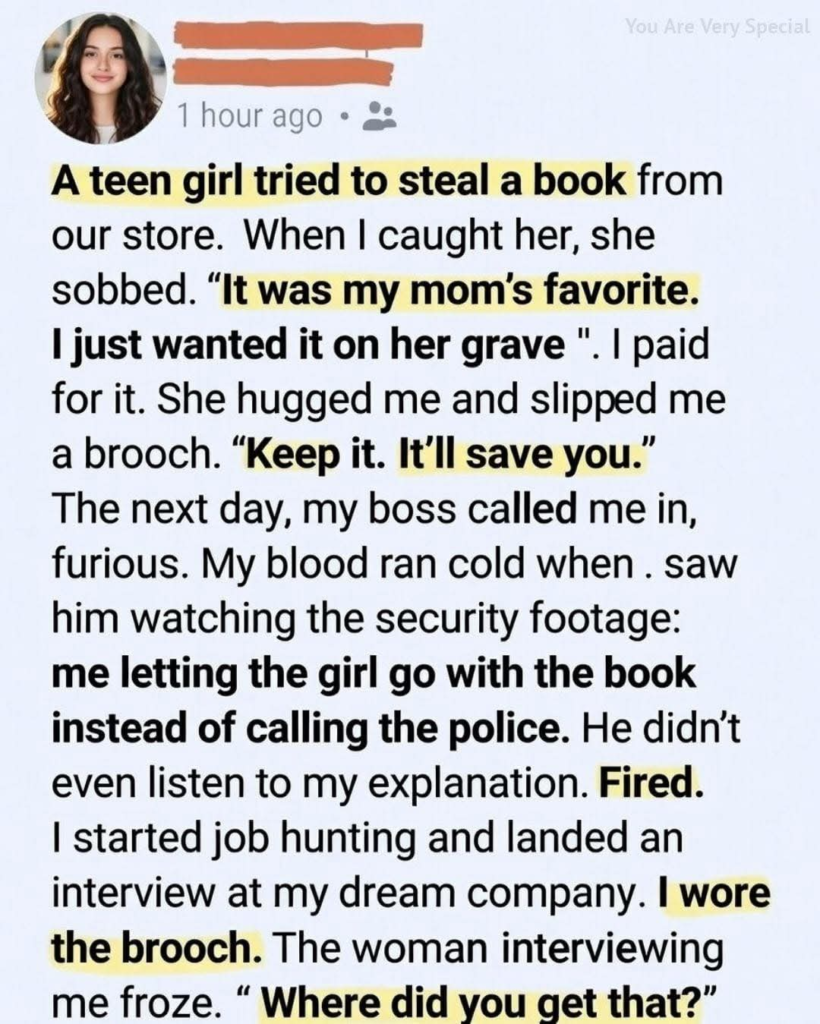
Late one afternoon, sunlight spilled through the dusty windows of the little bookstore where I worked, turning the air golden and warm. The place always smelled faintly of old paper and vanilla candles, a scent I’d grown used to over the years. I was restocking a display near the classics section when I noticed a teenage girl lingering too long by the shelf.
She kept glancing around.
Then I saw it — a worn paperback slipping beneath her oversized hoodie.
Our store had a clear procedure for theft. Call security. File a report. No exceptions.
But when I approached her quietly and asked her to come with me, she didn’t run. She didn’t argue. She just broke down.
Through shaking breaths, she told me the book had been her mother’s favorite. Her mom had passed away recently. That day would have been her birthday. She didn’t have money, she said, but she wanted to leave something meaningful at her grave. Something her mother had loved.
I stood there, holding the book, caught between policy and humanity.
Instead of escalating the situation, I walked to the register and paid for it myself.
It wasn’t heroic. It was instinct.
When I handed it back to her, she looked stunned. Then she reached into her pocket and placed something small into my hand — a delicate silver flower brooch with a striking blue stone at its center.
“It’s lucky,” she whispered. “It was my mom’s. I think you should have it.”
Before I could protest, she disappeared out the door, leaving me holding a piece of her story.
The consequences came quickly.
The next morning, my manager summoned me to his office. He replayed the security footage without emotion, framing the act as a breach of trust rather than an act of compassion. To him, I had allowed theft. End of story.
I was dismissed on the spot.
Oddly, I didn’t feel crushed walking out with my small box of belongings. I had worked there for years, but somewhere along the way, that cozy bookstore had become a place where I hid from bigger ambitions. I’d studied architecture before taking the job, telling myself I’d return to it “someday.”
Losing the job felt less like failure and more like a door closing so another could finally open.
A week later, I sat in the lobby of an architecture firm I had admired for years. The space was all glass and steel — everything the bookstore wasn’t. On a whim, I pinned the silver brooch to my blazer that morning. I’m not even sure why. It just felt right.
During the interview, the hiring manager’s eyes locked onto the brooch mid-sentence. Her expression shifted from professional calm to stunned silence.
She excused herself and asked me to follow her.
Moments later, I found myself standing in the CEO’s office. He was older, dignified, but visibly tired. The second he saw the brooch, the color drained from his face.
He stood slowly and stepped closer.
“That pin,” he said quietly. “Where did you get it?”
I explained the story — the girl, the bookstore, the book.
He sank into his chair.
The brooch, he told me, had belonged to his late wife. It had disappeared the same week his daughter, Mia, ran away after her mother’s death. Grief had torn through their home. Words had been said that neither of them could take back. And then she was gone.
The brooch was the last piece of her mother she had taken.
He believed he’d never see either of them again.
What I didn’t know was that Mia had been quietly reconnecting with him in recent months. The brooch had been missing — until now. Somehow, the small act in that bookstore had become a bridge neither of them expected.
He hired me that day.
Not because of the brooch.
Not because of sympathy.
But because, as he put it, “Anyone who chooses compassion when it costs them something understands what it means to build with purpose.”
Today, I design spaces that matter. And sometimes, when Mia visits the office, we share a quiet look across the room — an unspoken acknowledgment of the strange way our lives intersected.
The brooch still rests on my lapel.
I don’t think of it as lucky.
I think of it as proof.
Proof that one decision — a small, inconvenient kindness — can shift the course of your life. Sometimes losing something safe is what finally pushes you toward something extraordinary.

Dedicated and experienced pet-related content writer with a passion for animals and a proven track record of creating engaging and informative content. Skilled in researching, writing, and editing articles that educate and inspire pet owners. Strong knowledge of animal behavior, health, and care, combined with a commitment to delivering high-quality content that resonates with audiences. Seeking to leverage writing skills and passion for pets to contribute to a dynamic and mission-driven team.