
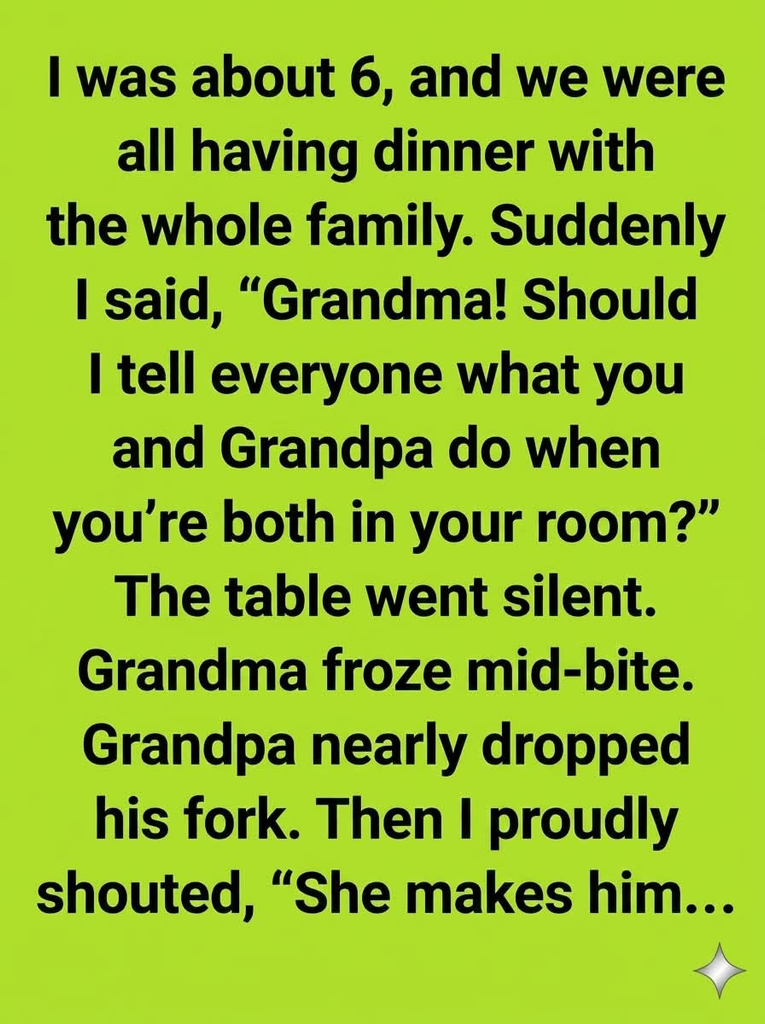
When I was six years old, I thought family dinners were the perfect time to tell everyone anything interesting that had happened. I didn’t understand yet that adults had private matters, that some things were better discussed quietly, or that choosing the wrong words could make an innocent comment sound much more serious.
Every holiday, my family gathered around a big wooden dining table that normally stayed stored away. Whenever that table appeared, we knew it was going to be a special day.
That evening, the table was covered with food. There was roasted chicken, warm bread, vegetables, and Grandma’s famous cornbread. Everyone was talking at the same time. My aunts were having a conversation across the table, my cousins were making jokes, and Grandpa was telling one of his favorite fishing stories.
I had heard that story many times before, but Grandpa always told it as if it had happened yesterday.
For a while, I just sat there and listened.
Then I suddenly remembered something.
I had recently learned that family dinners were about sharing. Adults told stories, children talked about school, and everyone was supposed to join the conversation.
So I decided I had something important to contribute.
Right in the middle of Grandpa’s fishing story, I sat up and looked at Grandma.
“Grandma,” I said loudly, “should I tell everyone what you and Grandpa do when you’re alone in your room?”
The whole table went silent.
It was almost as if someone had turned off the sound.
Grandma stopped eating.
Grandpa stopped talking.
My mom nearly choked on her drink, and my dad quietly said, “Oh boy.”
My aunts looked at Grandma. My cousins stopped eating and stared at me.
I had absolutely no idea why everyone suddenly looked so worried.
Grandma slowly put down her fork.
“Sweetheart,” she asked carefully, “what did you see?”
Grandpa closed his eyes and leaned back as if he already knew he was in trouble.
I smiled because I knew exactly what I wanted to say.
“She makes him fold the laundry!”
For a moment, nobody moved.
Then the entire table burst into laughter.
My aunt covered her face. Another aunt started wiping tears from her eyes. My uncle almost knocked over his glass. My cousins kept repeating my words because they thought it was even funnier the second time.
My mother finally stopped laughing long enough to ask me,
“That’s what you meant?”
I nodded.
“Of course. Grandma makes Grandpa fold the laundry.”
Grandma covered her face while laughing.
Grandpa let out a huge sigh and shook his head.
“Well,” he said, “she’s telling the truth.”
That only made everyone laugh harder.
I sat there completely confused.
I couldn’t understand why folding laundry was so funny. As far as I knew, I had simply noticed something that happened regularly and thought everyone would be interested.
And apparently, they were.
Looking back, I realize that the funniest part wasn’t even what I said. It was how everyone interpreted my words before they knew what I actually meant.
I had no intention of embarrassing Grandma or Grandpa. I wasn’t trying to reveal anything inappropriate. I was just a six-year-old kid who thought he had an interesting observation to share.
But I had chosen my words badly.
What sounded mysterious to the adults was completely ordinary to me.
That little misunderstanding eventually became one of those family stories that never really disappeared.
Whenever our family talked about holiday dinners, someone would eventually bring it up.
Grandma would laugh and shake her head.
Grandpa would repeat his famous line about me being right.
Even relatives who were not there that night eventually heard the story.
With every retelling, it somehow became funnier.
As I grew older, I started to understand why the adults had reacted so strongly.
They heard one thing when I said, “what you and Grandpa do when you’re alone.”
I meant something completely different.
That taught me an important lesson about communication.
It isn’t enough to know what you mean. You also have to think about how other people might understand your words.
Timing matters.
The words you choose matter.
And sometimes, a simple sentence can sound completely different from what you intended.
At six years old, I obviously didn’t know any of that.
I learned it through laughter.
The story also became part of our family’s shared history. Families often have little moments like this. A funny mistake, an unusual comment, an embarrassing moment, or a joke can become something everyone remembers for years.
Those memories become especially meaningful as time passes.
People grow older. Children become adults. Grandparents age. Families move to different places. Holiday dinners become less frequent because everyone gets busy with work, school, relationships, and other responsibilities.
But one funny story can bring everyone back to the same moment.
For my family, this was one of those stories.
It wasn’t a scandal.
Nobody had actually revealed a serious secret.
Nobody was hurt.
It was simply a misunderstanding caused by a little kid who didn’t realize how dramatic his choice of words sounded.
What made the situation even better was the way Grandma and Grandpa handled it.
They could have become angry with me. They could have told me that I shouldn’t interrupt dinner or talk about private things.
Instead, they laughed.
Grandpa especially knew how to turn an awkward moment into a joke.
His response made everyone relax, and the embarrassing moment became something we could all enjoy.
That taught me another valuable lesson.
Not every mistake needs to become a big problem.
Sometimes you can laugh, explain what happened, and move on.
Family gatherings are never perfect.
Someone tells the same story for the tenth time.
Someone talks too loudly.
A child interrupts at exactly the wrong moment.
Someone forgets a dish in the kitchen.
Someone says something that comes out completely wrong.
But those little mistakes are often the moments people remember most.
The best family stories are not always carefully planned. Sometimes they happen when nobody expects them.
That holiday dinner was one of those moments for me.
I thought I was simply sharing something I had noticed.
Instead, I accidentally created a family legend.
Years later, I still find it funny when I think about how serious everyone became for those few seconds.
I was expecting curiosity.
They were expecting a scandal.
What they got was a six-year-old exposing Grandpa’s biggest household responsibility:
folding the laundry.
And somehow, that tiny misunderstanding gave my family a story we could laugh about for years.
The “secret” I revealed that night was never really a secret.
It was just laundry.
But apparently, at a family dinner, even laundry can sound like breaking news.
If you want, I can also make this more emotional, more funny, or more viral/Facebook-story style while keeping the wording simple.

Dedicated and experienced pet-related content writer with a passion for animals and a proven track record of creating engaging and informative content. Skilled in researching, writing, and editing articles that educate and inspire pet owners. Strong knowledge of animal behavior, health, and care, combined with a commitment to delivering high-quality content that resonates with audiences. Seeking to leverage writing skills and passion for pets to contribute to a dynamic and mission-driven team.