
Living with a teenager can feel less like parenting and more like negotiating with a moody housemate. One minute they’re your sweet child, the next they’re slamming doors, rolling their eyes, and insisting they know better than you. Even calm, patient parents can reach a moment where they realize something has to change.
For Heidi Johnson, a single mother living in Alaska, that moment arrived in 2015. Her son Aaron was only 13, but lately he’d been acting as if he ran the house. He had started earning a bit of money through his YouTube channel, and with that income came an attitude shift. Rules suddenly felt optional to him. Chores were beneath him. And respect, in his mind, was negotiable.
Arguments became more frequent. Aaron spoke to his mother in ways she found hurtful and dismissive, insisting that because he made his own money, he should be allowed to live however he wanted. One afternoon, a disagreement over responsibilities spiraled into something bigger. He flat-out refused to help around the house and made it clear he didn’t think she had the right to tell him what to do.
Heidi felt the familiar urge to yell—but she stopped herself. She knew shouting wouldn’t teach him anything. Instead, she sat down at her desk, grabbed a sheet of paper, and decided to respond in a way her son might finally understand.
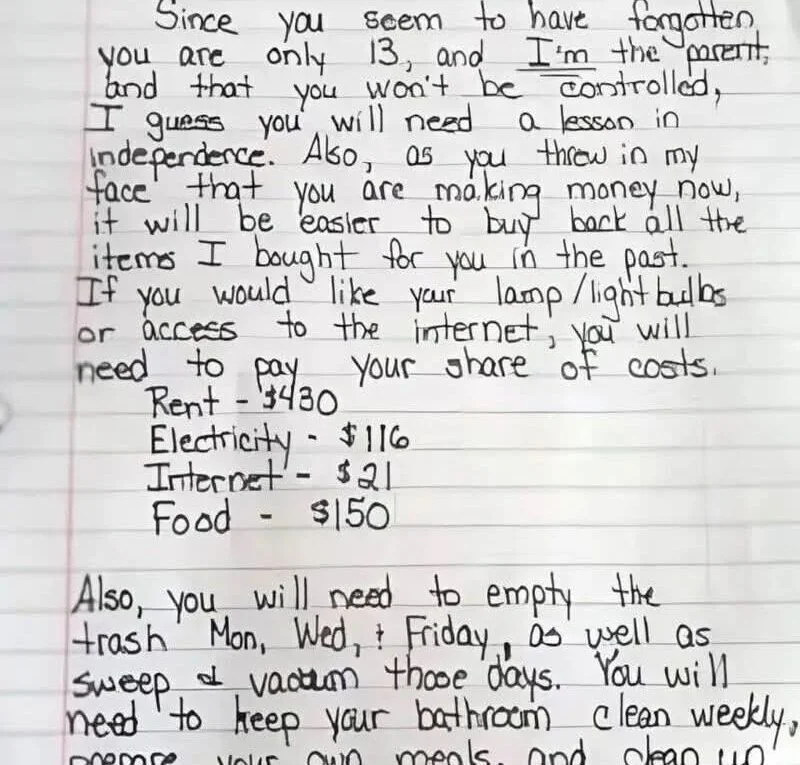
She wrote him a letter, but not the warm, emotional kind. It was calm, firm, and deliberately formal, written as though she were addressing a tenant rather than a child. In it, she explained that if Aaron truly wanted to live like an independent adult, then he needed to accept adult responsibilities as well.
She laid it out plainly. Rent would no longer be free. Utilities weren’t magically paid for. Food didn’t appear in the fridge on its own. She itemized the costs—rent, electricity, internet, groceries—and made it clear that if he failed to clean up after himself, there would be additional “fees” for the work she’d have to do. Chores weren’t optional; they were part of contributing to the household.
At the end of the letter, she offered him a choice. If he wanted to go back to being her child instead of treating their home like a hotel, they could talk and reset the rules together.
Heidi taped the letter to Aaron’s bedroom door and walked away.
The reaction was immediate. Aaron tore the paper down, crumpled it up, and stormed out of the house, furious. He wanted the freedom of adulthood, but the responsibility that came with it felt overwhelming. For the rest of the evening, the house was quiet. Eventually, he came home and went straight to his room without saying a word.
By the next day, the anger had softened into something else—reflection. Aaron came out of his room calmer than before. He handed over a few things he knew he hadn’t earned the right to use freely and admitted that he’d crossed a line. He told his mother he’d been acting entitled and asked what he could do to fix things.
They talked. Really talked. Not just about chores, but about respect, effort, and how the real world actually works. Together, they agreed on clearer expectations and a more balanced set of rules that made sense for a 13-year-old learning independence, not pretending to already have it.
Like any teenager, Aaron didn’t transform overnight. There were still difficult moments. But something important had shifted. Heidi later said that, oddly enough, the incident brought them closer and helped her son better understand her role—not as an obstacle, but as a guide.
What Heidi didn’t expect was what happened next.
Before Aaron had even seen the letter, she had snapped a photo of it and shared it on Facebook, thinking only a few friends might get a laugh out of it. She hadn’t realized her post was public. Within hours, it was everywhere.
Parents shared it by the thousands. Some applauded her creativity and firmness, calling it a brilliant example of tough love. Others criticized her harshly, accusing her of embarrassing her son or turning a private family issue into public spectacle. News outlets picked it up, and soon the letter was being discussed across the world, translated into different languages and debated endlessly online.
When criticism poured in, Heidi stood her ground. She explained that the letter wasn’t about punishment or shame—it was about teaching a lesson. Freedom, she said, only works when it’s paired with responsibility. And while Aaron didn’t enjoy the experience in the moment, even he later admitted it made him stop and think.
Experts weighed in, pointing out that the story struck a nerve because it reflects a modern parenting challenge. Kids today can earn money, build online platforms, and feel grown long before they’re emotionally ready to handle adult expectations. The line between independence and immaturity can blur quickly.
The internet eventually moved on, as it always does. But for Heidi and Aaron, the lesson stuck. The viral attention faded, yet the understanding they reached together remained.
Years later, Heidi said she didn’t regret writing that letter. Parenting, she believed, isn’t about being liked all the time—it’s about preparing your child to stand on their own someday. And if a single piece of paper taped to a bedroom door helped make that point, then it was worth it.

Dedicated and experienced pet-related content writer with a passion for animals and a proven track record of creating engaging and informative content. Skilled in researching, writing, and editing articles that educate and inspire pet owners. Strong knowledge of animal behavior, health, and care, combined with a commitment to delivering high-quality content that resonates with audiences. Seeking to leverage writing skills and passion for pets to contribute to a dynamic and mission-driven team.