
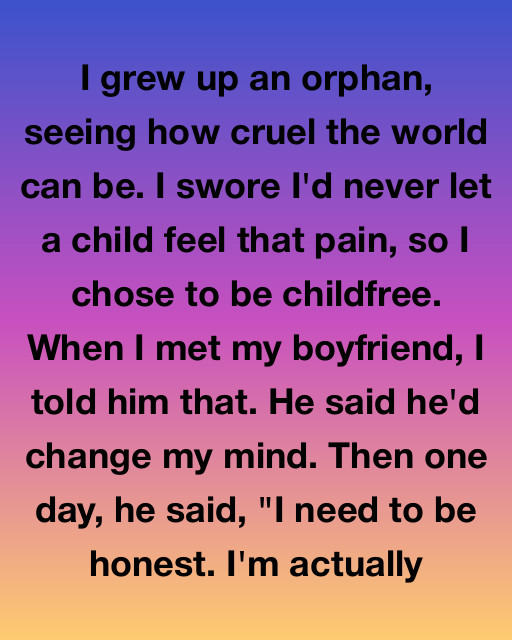
I spent my childhood without parents, shuffled between institutions that never felt like home. The world showed me its harshest edges far too early, and I promised myself that no child would ever depend on me only to be abandoned. That vow shaped everything—I chose a life without children, not out of dislike, but out of fear of repeating the cycle.
When I met Daniel, I warned him early on. He brushed it off with a confident little smile and said, “You’ll change your mind someday.” I thought he was joking—just harmless confidence. But months later, out of nowhere, he sat across from me at a small, candlelit restaurant and said quietly, “I need to tell you something important. I’m the guardian of my niece—she’s seven—and my nephew, who’s four.”
For a moment, I forgot how to breathe.
The warm glow of the candle between us suddenly felt cold and foreign. We had been together almost a year. It was the most open, secure relationship I’d ever had. I had trusted him with everything—my history, my wounds, the fragile pieces of me I rarely let anyone see. And he had never mentioned children. Not once.
My past came rushing back like a ghost. I remembered the dormitory lights in those foster homes, the hollow expressions on the faces of kids like me—kids who were nobody’s priority. I remembered the constant fear of being left behind. Because of that, I swore I would not put a child through the kind of life I’d lived—or risk leaving them without a safe place if the world took an unexpected turn.
Daniel knew this. He knew my stance wasn’t flexible. He knew my history wasn’t a story—it was a scar. And yet he’d kept something so monumental hidden.
“What do you mean, Daniel?” I murmured, barely recognizing my own voice. “You’ve never mentioned children. You live alone. I’m at your place almost every night.”
He looked like a man bracing for impact. “Their names are Lily and Sam. My sister and her husband died suddenly eight months ago. They were overseas, and I had to go there, take care of everything, and bring the kids back to London.”
Eight months. An entire relationship built alongside a secret that big.
“Where are they now?” I asked, my heart pounding.
“With my aunt Martha in Surrey,” he explained, running a hand through his hair in pure desperation. “She’s wonderful with them, but she’s elderly. She can’t manage them full-time. I’m with them every weekend. I handle school, clothes, everything.”
He went on to describe the chaos, the grief, the transition. How terrified he had been to tell me. How he thought I’d leave the moment I realized being with him meant being part of their world.
I couldn’t sit there any longer. I stood, walked out of the restaurant, and left him behind. It wasn’t the children—it was the weight of the decision he had forced into my hands. Suddenly, I wasn’t facing an abstract fear. I was staring into the lives of two real, vulnerable kids who had already suffered enough.
For three days I ignored him, torn between love and terror, caught in a battle between who I had become and who I might need to be.
On the fourth day, he sent one message:
“Please. Just meet them once. Martha needs help with something.”
Despite every instinct screaming at me to protect myself, I drove to Surrey.
Martha’s cottage radiated warmth from the moment I stepped inside. The children were shy at first—Lily watched me with a seriousness beyond her age, while little Sam tried to hide behind Martha’s leg but peeked out every few seconds. I helped Martha prepare dinner, grateful that the kids barely paid attention to me.
But then Lily noticed the small silver locket I always wore.
“Did your mum give you that?” she whispered.
I froze. “No. A kind woman gave it to me when I was your age,” I said softly.
It was the closest I had come to speaking about my upbringing in years.
When I finally prepared to leave, Sam toddled up to me, silent and serious, and placed a wrinkled drawing in my hand—a bright purple house with uneven stick figures. A tiny offering of trust.
Driving home, I realized something important: these children were not the terrifying burden I had always imagined. They were just two kids seeking safety and love—things I understood better than most.
So I didn’t leave Daniel. I chose to try, slowly and carefully. I kept my own place, but every Saturday, I joined him in Surrey. I helped with groceries, homework, errands. I kept emotional distance, convincing myself I was simply helping, nothing more.
But life had other plans.
A month later, after I upgraded my old car to a sensible family one, Martha called me in confusion.
“Eleanor, dear, Daniel just told me he isn’t looking for a new house anymore. He said he found a permanent solution.”
That didn’t make sense. He couldn’t afford a big home, not with everything he was paying for the kids. So I confronted him. He dodged most of my questions but mentioned a long-term rental agreement he’d secured—a lovely, spacious house near Martha’s. The kids could stay in their school. Stay close to her.
It sounded perfect. Too perfect.
Weeks later, while helping Lily unpack in her new room, I found the truth buried in one of her boxes:
a laminated court document summarizing the children’s inheritance.
I read it twice, my hands shaking.
Their parents had left them a substantial estate—but legally, the money could only be used for housing that exceeded Daniel’s own income. He was obligated by law to put every spare pound he earned into supporting them. He had been living off his small savings for months so he wouldn’t have to touch the children’s protected funds.
He hadn’t hidden the truth to deceive me.
He had hidden it because he feared I would see the burden, not the love.
Because he worried I would walk away from a future where he—and the children—would always come first.
In that moment, something inside me shifted.
The walls I had lived behind for years—the armor built from childhood pain—finally cracked.
I went to him, tears streaming, not from anger but from recognition. We talked for hours. Then we made a plan. The children’s trust secured the beautiful house in their name, just as the law required. I sold my flat and created a joint savings and education fund to give Lily and Sam the stability I never had.
And slowly, without even realizing it, I stopped calling myself “child-free.”
I became Aunt Eleanor—steady, present, loving.
The fortress around my heart finally softened, reshaping itself into something open and alive.
I discovered that the real danger was not loving—it was refusing to try.
Life Lesson:
True courage isn’t found in avoiding pain. It’s choosing love even when it terrifies you, trusting that vulnerability is the only doorway to safety, belonging, and family.
If this story touched your heart, don’t forget to like and share.

Dedicated and experienced pet-related content writer with a passion for animals and a proven track record of creating engaging and informative content. Skilled in researching, writing, and editing articles that educate and inspire pet owners. Strong knowledge of animal behavior, health, and care, combined with a commitment to delivering high-quality content that resonates with audiences. Seeking to leverage writing skills and passion for pets to contribute to a dynamic and mission-driven team.